Learn How to Draw Robots 🤖✍️: A Fun and Practical Guide for All Ages
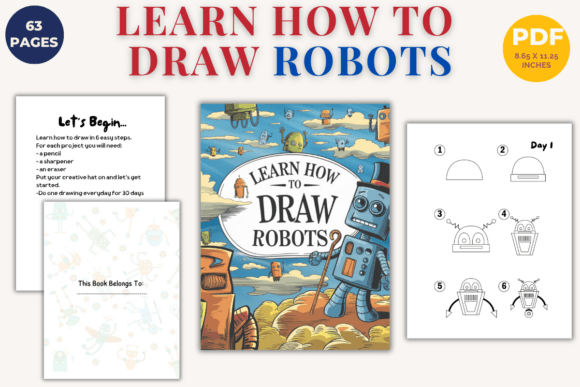
If you're fascinated by robots and want to learn how to draw them, Learn How to Draw Robots 🤖✍️ is the perfect resource for you. This interactive PDF journal is designed to help beginners and kids develop their artistic skills while exploring the creative world of robot design. With its easy-to-follow instructions, practice pages, and imaginative prompts, this guide makes learning to draw robots both enjoyable and accessible.
Whether you're a parent looking for an engaging activity for your child or an adult wanting to explore your creative side, Learn How to Draw Robots 🤖✍️ offers something for everyone. Its large 8.65 x 11.25-inch format provides ample space for drawing, making it ideal for both hand-drawn and digital use. The book also includes a personalized "This Book Belongs To" page, allowing you to make it uniquely yours.
Challenges and Goals in Learning to Draw Robots
Many people who want to learn how to draw robots face common challenges, such as difficulty visualizing robot designs, understanding proportions, or developing consistent techniques. These obstacles can be discouraging, especially for beginners. However, with the right tools and guidance, these hurdles can be overcome.
One of the primary goals for anyone interested in robot drawing is to build confidence in their artistic abilities. Many individuals feel intimidated by the idea of creating complex designs, but Learn How to Draw Robots 🤖✍️ simplifies the process with step-by-step instructions that break down each drawing into manageable parts. This approach not only helps users improve their skills but also makes the learning experience less overwhelming.
How Learn How to Draw Robots 🤖✍️ Can Help
Learn How to Draw Robots 🤖✍️ addresses these challenges by offering a structured yet flexible learning environment. Each section of the book guides users through the basics of robot design, from sketching simple shapes to adding intricate details. The included practice pages allow for repeated attempts, helping users refine their technique over time.
The book also encourages creativity through its various prompts and exercises. Instead of just copying pre-drawn examples, users are invited to imagine and design their own unique robots. This fosters a deeper understanding of the subject and helps develop originality in their work.
Practical Applications and Outcomes
Using Learn How to Draw Robots 🤖✍️ can lead to a variety of practical outcomes. For children, it serves as an excellent tool for developing fine motor skills, attention to detail, and problem-solving abilities. For adults, it can be a fun way to relax, express creativity, or even explore new artistic interests.
Additionally, the book's printable and digital format makes it versatile for different learning environments. Whether used at home, in a classroom, or on a tablet, Learn How to Draw Robots 🤖✍️ adapts to the user's needs. This flexibility ensures that the learning experience remains engaging and convenient for all users.
Examples and Recommendations
Consider using Learn How to Draw Robots 🤖✍️ as part of a weekly art routine. Set aside time each week to work on a new robot design, focusing on different aspects such as mechanical features, color schemes, or movement. This consistent practice will help build both skill and confidence.
For educators, the book can be a valuable addition to art classes or STEM programs. It combines elements of technology and creativity, making it a great resource for interdisciplinary learning. Teachers can use the practice pages to assign drawing tasks or encourage students to collaborate on group projects.
Different Approaches to Robot Drawing
Each user may approach robot drawing differently based on their interests, goals, and learning styles. Some may focus on realistic, detailed designs, while others may prefer more abstract or whimsical interpretations. Learn How to Draw Robots 🤖✍️ accommodates these variations by providing a foundation that can be adapted to individual preferences.
For example, a beginner might start by following the step-by-step instructions closely, gradually building up to more complex designs. An experienced artist, on the other hand, could use the book as inspiration to experiment with new techniques or incorporate robotics into their existing work.
Usefulness and Implementation
The true value of Learn How to Draw Robots 🤖✍️ lies in its ability to provide practical, actionable guidance. It doesn't just teach how to draw robots—it empowers users to create, innovate, and express themselves through art. By focusing on real-world application, the book ensures that every lesson contributes to meaningful progress.
When implementing the techniques from Learn How to Draw Robots 🤖✍️, it's important to stay patient and persistent. Artistic growth takes time, and each drawing is a step forward. Regular practice, combined with the support of this guide, can lead to noticeable improvements in skill and creativity.
Ultimately, Learn How to Draw Robots 🤖✍️ is more than just a drawing book—it's a gateway to exploration, self-expression, and artistic development. Whether you're a child taking your first steps in drawing or an adult rediscovering your creative side, this resource offers the tools and encouragement needed to bring your robotic visions to life.